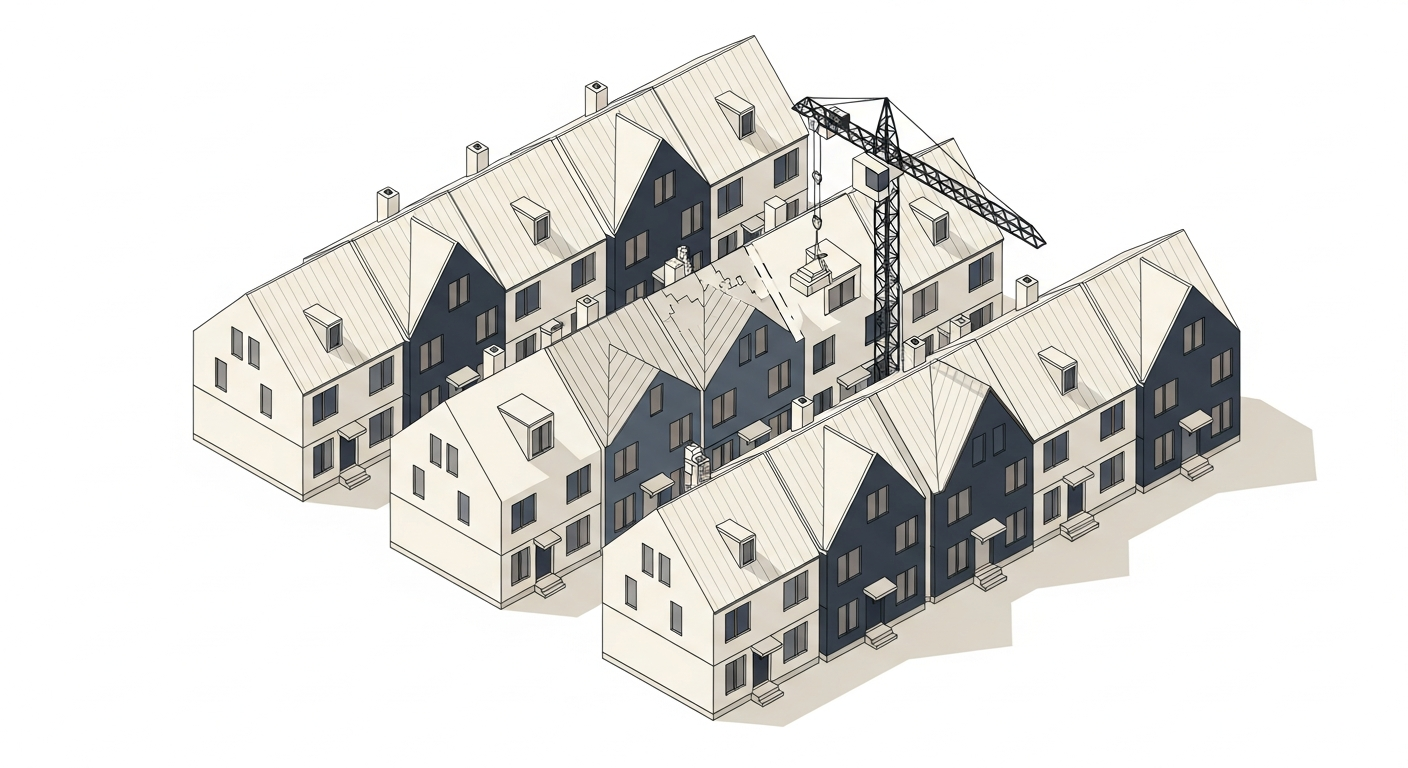
Sweden Builds Homes in Factories. That is Why They are Cheaper.
← Back to all postsSweden manufactures roughly 45% of its new single-family homes off-site in factories. The components are precision-cut, insulated and pre-fitted before a single shovel touches the ground. Once the parts arrive on-site, a house can be assembled in a matter of days. The quality is high, the waste is low and the cost per square foot is meaningfully less than traditional stick-built construction.
I have been thinking about this because one of the most common questions I get right now is whether new construction is worth looking at. The answer, in the right situations, is yes. Understanding why Sweden does this well helps explain what to look for here at home.
Inspired by: The New York Times, June 8, 2024
Why Factory-Built Is Different
Traditional home construction is sequential and weather-dependent. The foundation goes in, then framing, then roofing, then electrical and plumbing. Each trade waits on the last. Rain delays everything. Material waste on a typical job site runs 10 to 15%.
Modular construction flips that. Walls, floors and roof panels are built simultaneously in a climate-controlled factory. Tolerances are tighter because the work is done by machines and specialized crews rather than rotating subcontractors. The finished modules are trucked to the site and craned into place. What used to take seven months can take two.
Sweden got good at this partly out of necessity. Labor is expensive there, winters are brutal and the country made a deliberate policy decision decades ago to standardize components across the building industry. Companies like Lindbäcks and Derome now export their systems across Europe. The model works at scale because the whole supply chain is built around it.
Where the U.S. Is Starting to Catch Up
Modular and prefab construction has historically had a reputation problem in the U.S. People associate it with trailer parks or cheap mobile homes. That perception is outdated. Companies like Veev, Mighty Buildings and Clayton Homes are building factory-produced homes that are architecturally indistinguishable from site-built ones and in many cases better insulated and more energy-efficient.
California in particular has started paying attention. The state's housing shortage is severe enough that speed and cost matter enormously. ADUs built with prefab panels can go from permit approval to move-in in under 90 days. Some developers are now applying the same approach to larger infill multifamily projects in inland markets where land is cheaper and logistics are manageable.
What This Means If You are Buying Now
For most buyers in Orange County or coastal LA, modular homes are not yet a primary option. The existing housing stock dominates and land constraints make large-scale factory-built projects hard to execute near the coast.
If you are open to inland markets, however, — the Inland Empire, parts of San Bernardino County or the Antelope Valley — new construction communities increasingly include factory-built components. Builders there are sometimes offering rate buydowns and closing cost credits that resale sellers will not match. The effective rate difference can be 0.5 to 1 point lower than what you would get on a comparable resale home.
It is worth running those numbers. A rate that is three-quarters of a point lower on a $550,000 loan saves you roughly $275 a month. Over five years that is $16,500 in your pocket instead of the bank's.
If you want to look at what new construction options are actually available for your budget and timeline, I am happy to help you think through it. Call or email and we will start from your numbers.
Rates shown are for illustrative purposes only and are not a commitment to lend. Actual rates depend on credit profile, loan type, property type and market conditions. Not all borrowers will qualify.